
Make your home office more home than office
There is a particular moment, usually around the second week of September, when the light changes and everyone remembers they have a job.
The holiday washing is finally done. The children have gone back. And there, in the corner of the spare room, sits The Desk. You probably bought it in a hurry in 2020, I imagine it’s got a wobbly leg, and I know there’s an unsightly tangle of cables that seem to be breeding. You sit down at it and feel part of your soul leave your body.
I see this more often than you'd think. People spend years agonising over a sitting room and then work forty hours a week hunched in a pokey corner. So, let’s talk home offices – specifically, how to style one that feels like it’s part of your home, not like it’s been surgically removed from an office block.
Because that's the real problem, isn't it? Most home offices don't look bad. They look corporate. And corporate, in a home, is deeply unsettling.
Start with the walls, not the desk
Everybody starts with the desk. Don't.
The thing you look at all day is the wall opposite, and the thing everyone else looks at, on every video call, is the wall behind you. Those two surfaces do more for the feel of a room than any piece of furniture you could buy.
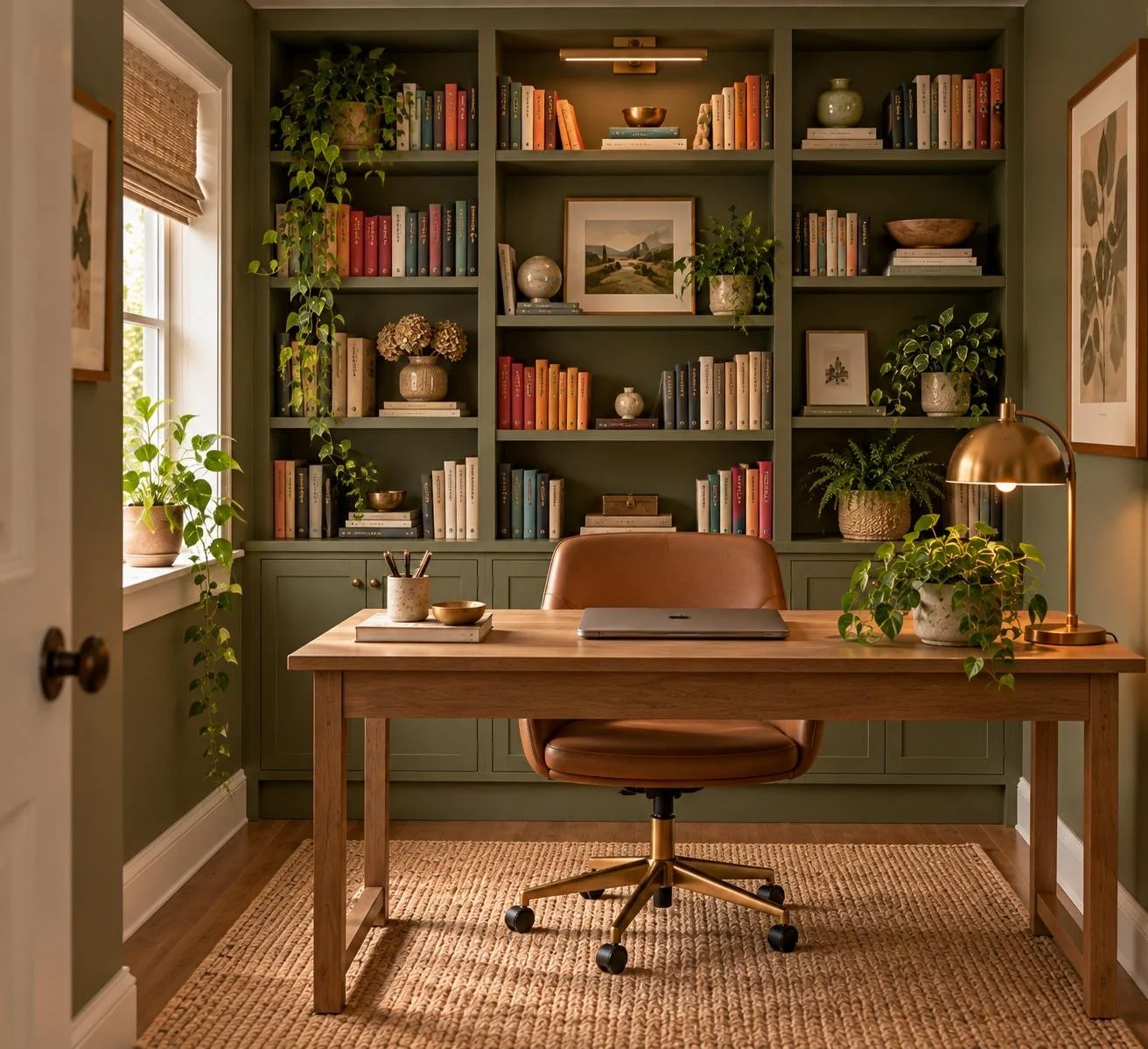
If you do one thing to improve your home office, paint those walls. Not the whole room necessarily; just the wall behind the desk – or the alcove the desk sits in – and the wall you’ll be looking at. Adding a deep, absorbing colour instantly turns "corner of the spare room" into "study," which is a remarkable return on a tin of paint and a wet Sunday.
If you're on video calls a lot, the wall behind you is really important. It doesn’t want to be a blank corporate backdrop, but equally it doesn’t want to distract or compete with you for attention. A well-stocked wall of books does this better than almost anything else – it's visually rich without being busy; it says something about you without saying it too loudly. A gallery wall of clashing frames, by contrast, tends to pull the eye away from your face mid-sentence, which is exactly what you don't want.
Working from a shared space? Borrow, don't convert
Not everyone has a spare room to sacrifice to work, but trying to fully redecorate a dining room into an office rarely works well. The better approach is to borrow rather than convert.
Keep your workspace small, functional and “mobile” so that you can pack everything away at the end of the working day. The whole point is that your office can go back to being a dining room in under two minutes, not that it becomes a hybrid that never quite works as either.
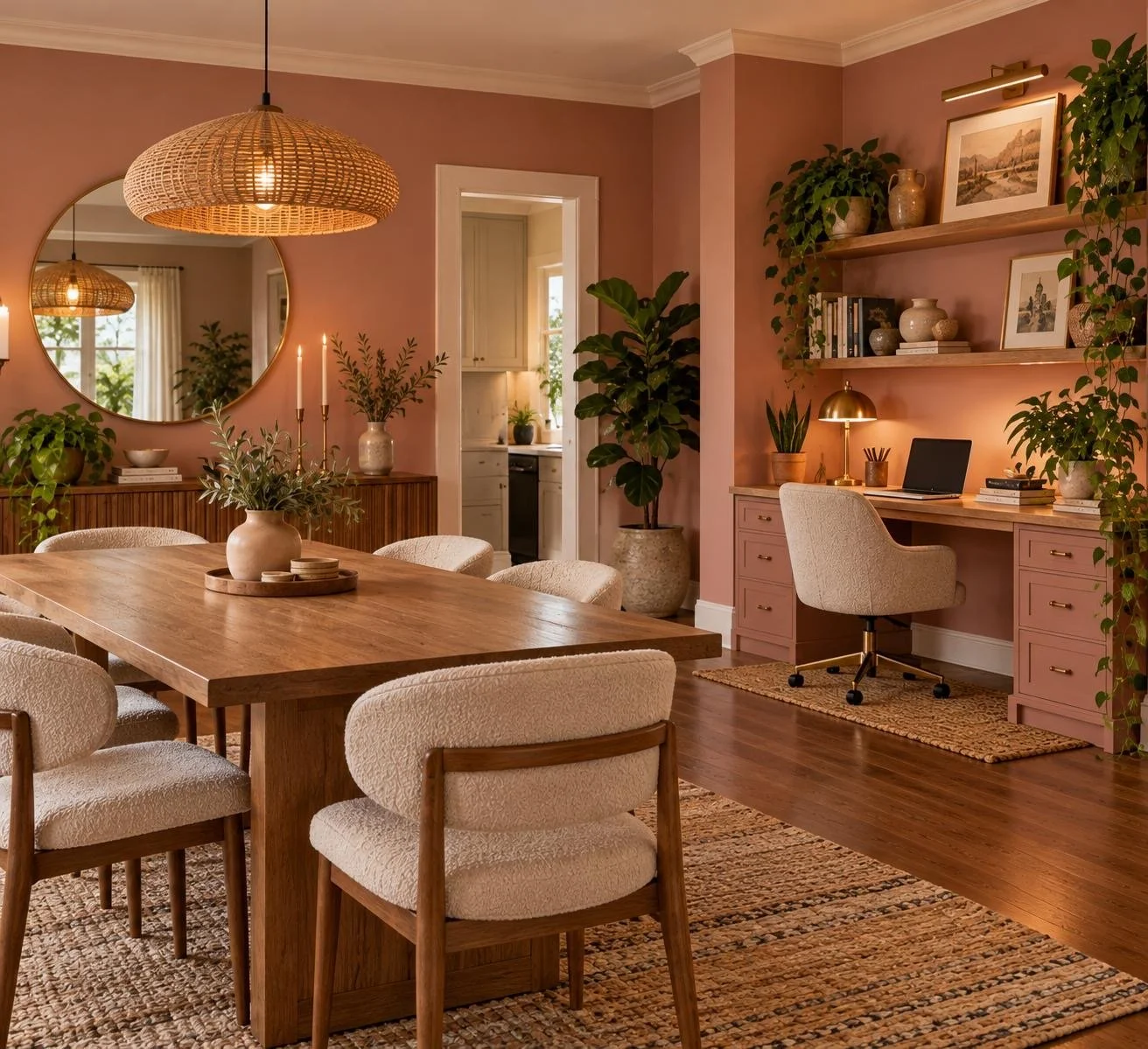
Don’t try to add "office" furniture into a room that already has a job. The dining table can serve as a desk by day and serve dinner by night. A runner or tray that looks intentional on a dining table can just as easily corral your desk clutter during the day. The aim isn't to make the room look like an office – it's to make the office disappear convincingly when you need it to.
If you've got a whole room to yourself
A designated room for an office is a genuine luxury, and it's worth treating it as more than just "the place I happen to work." If calm and focus matter more to you than anything else, warm, earthy pinks are a wonderful choice – restful without being flat, nurturing without tipping into twee, and far more forgiving of changing light than people expect.
Pair the colour with real house plants rather than artificial ones. This isn't just an aesthetic preference – plants genuinely help clean the air in a room you're sitting in for hours at a time, and they bring a lively, living quality to a space that can otherwise feel very static and sedentary. Choose something that suits the room's actual light rather than the plant you liked best in the shop; a happy, slightly ordinary plant beats a magnificent one that's visibly struggling.
Choose your colour by the job, not by the trend
I'm going to be somewhat unfashionable here and say: ignore what's trending for a moment and think about what you actually do at that desk.
If your work is detailed and you need to concentrate – spreadsheets, coding, contracts, anything where you lose the thread if someone breathes near you – go deep and enveloping. Inky blues, deep greens, chocolate browns. Dark colours reduce visual noise. Your eye stops wandering because there's nothing for it to wander to. It sounds counterintuitive to paint a small room dark, but a small dark room feels cocooned rather than cramped, and cocooned is exactly what you want at 3pm on a Tuesday.
If your work is creative or involves a lot of talking – design, writing, calls, teaching – go warmer and lighter. Soft clay tones, warm stones, muted terracottas. You want a room that feels open and generous, because you're generating something rather than grinding through it.
If you're in the room at odd hours – early mornings, dark winter afternoons – pay attention to how the colour behaves under lamplight, not just daylight. This is where people come unstuck. A grey that looks sophisticated at 11am can look like wet concrete at 6pm in November. Always, always live with a sample for a few days. Stick it on the wall, look at it in the morning, look at it with the lamp on, look at it when you're tired and slightly cross. That's the real test.
Light it like a sitting room, not a supermarket
The single biggest offender in a corporate-feeling home office is the Big Light. One overhead bulb, blazing down, flattening everything.
You want at least two light sources at different heights, and ideally three. A desk lamp for the work. A floor lamp or a table lamp somewhere behind or beside you for ambient warmth. And then, if you can, something small and unnecessary – a tiny lamp on a shelf, a picture light, a candle in the darker months. It's the unnecessary one that does the emotional heavy lifting.
Warm bulbs throughout. This is non-negotiable. Cool white light simply shouldn’t exist outside a dentist's surgery – and even there I’m sure it’s unnecessary.
Hide the ugly, display the lovely
Every home office contains ugly, but unfortunately necessary, objects: printers, routers, cables, the box file marked ‘TAX’. These do not need to be on display.
The trick isn't more storage, it's closed storage for the ugly things and open storage for the lovely things. A cupboard, a wicker basket, a vintage chest – anything with a lid or a door. Then, on the open shelves, only things you genuinely like looking at: books, objects with a story, a plant you’ll actually keep alive.
Put something in the room that has nothing to do with work
This is the part people skip, and it's the part that actually stops a room feeling corporate.
An office decorated purely for productivity reads as a place of obligation. You need at least one thing in there that serves no function whatsoever: a piece of art you love, an odd bit of pottery from a holiday, a photograph, a strange little brass animal you bought because it amused you. Something that makes the room feel like it belongs to a person.
I have a five-inch Moomintroll on my desk. It serves no real purpose, granted, but it makes me smile – and that, apparently, boosts productivity.
And finally: sit somewhere decent
I know. It's the least glamorous advice in the world. But a beautiful room you can't bear to sit in for more than an hour isn't a working office, it's a set. If your budget is tight, spend it on the chair before the desk – a plain desk with a good chair beats a gorgeous desk with a dining chair pulled up to it every single time.
If you're staring at a corner you've been meaning to sort out, autumn is genuinely the best time to do it – you've got the whole dark half of the year ahead of you to enjoy the result.
I'm always happy to help talk through colours if you're stuck, whether that's a full consultation or just a nudge in the right direction. And if you'd like to test a shade or two before committing, do come and have a look at our sample pots in the showroom.